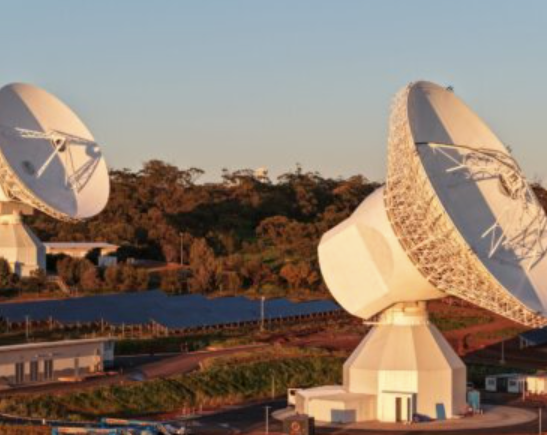
Technology is integral to deep space communication systems, facilitating the transmission of signals across astronomical distances. Advanced antenna designs and refined signal processing techniques are crucial for enhancing data integrity and minimizing latency. However, significant challenges persist, including signal degradation and the vast expanses of space. As exploration efforts intensify, new innovations in communication methods are emerging. These advancements may redefine how we connect with distant spacecraft and enable more ambitious missions ahead.
The Role of Antenna Technology in Deep Space Communication
Antenna technology serves as a critical component in deep space communication systems, facilitating the transmission and reception of signals over vast distances.
Effective antenna design is essential for achieving optimal performance, while frequency optimization ensures that signals remain clear and reliable amidst cosmic noise.
These elements work in tandem, enabling robust communication pathways that empower exploration and discovery beyond Earth’s confines, enhancing humanity’s quest for freedom in space.
Innovations in Signal Processing for Interplanetary Missions
Advancements in signal processing are redefining the capabilities of interplanetary missions, complementing the foundational work established by antenna technology.
Innovations such as adaptive algorithms enhance data transmission efficiency, allowing for real-time adjustments to varying conditions.
Moreover, sophisticated noise reduction techniques improve signal clarity, ensuring that critical information is transmitted accurately across vast distances, thus facilitating better communication with distant spacecraft and enhancing mission success.
Overcoming Distance: Challenges in Deep Space Communication?
Deep space communication presents multiple challenges that stem primarily from the immense distances involved.
Signal degradation occurs as electromagnetic waves travel vast expanses, diminishing signal strength and clarity.
Additionally, latency issues become pronounced, with delays in data transmission significantly impacting real-time communication.
These factors complicate mission control, necessitating advanced technologies to ensure effective interaction between Earth and distant spacecraft.
See also: totoking111com
Future Trends in Deep Space Communication Systems
As the exploration of outer space intensifies, innovative approaches are emerging in deep space communication systems to address the limitations of current technologies.
Future trends include the integration of quantum communication for enhanced security and efficiency, alongside advanced laser transmission methods that promise higher data rates and reduced latency.
These developments could revolutionize interstellar communication, enabling more profound exploration beyond Earth’s confines.
Conclusion
In the grand theater of cosmic communication, where signals traverse light-years at the speed of snail-mail, humanity bravely battles latency and degradation with cutting-edge antenna technology and signal processing innovations. Alas, while quantum communication and laser transmissions promise to elevate our interplanetary dialogues, one can’t help but wonder if our future deep-space conversations will still be punctuated by the universal silence of “Can you hear me now?” Truly, progress seems destined to echo across the void.